This morning I paid £90 for something that cost £4.
I wasn’t speeding.
I hadn’t parked illegally.
I hadn’t jumped a red light.
I drove through a tunnel.
A few weeks ago I travelled to Gatwick to pick up my uncle, who was visiting from the States. From there we were heading towards Harlow to see my other uncle.
The traffic was horrendous.
We were supposed to be going around the M25, but eventually we came off and ended up driving through London instead.
At some point, we went through the Silvertown Tunnel.
I remember approaching it. I remember driving through it.
What I don’t remember is seeing anything telling me I needed to pay £4 afterwards.
I’m not saying there wasn’t a sign.
I’ve subsequently found a Freedom of Information request showing where the signs are. They’re there.
But I was on an unfamiliar road, concentrating on where I was going and catching up with someone I hadn’t seen for a year.
I also knew I was in or around the ULEZ. My car is ULEZ compliant, so it would have been very easy for another road charging sign to become part of the noise.
Even my satnav and Google didn’t alert me to anything.
And if people noticed and understood every road sign they passed, nobody would ever get lost.
So I drove through the tunnel and carried on with my day.
£4 becomes £90
This morning Kelly rang me.
“Are you ready to be pissed off?”
Never a promising start to a Saturday morning.
There was a Penalty Charge Notice waiting for me.
It had been sitting in unopened mail for about a week because I’m not currently at the address all the time.
I’d failed to pay the £4 Silvertown Tunnel charge.
The penalty was £180.
But if I paid within 14 days, they’d generously reduce it to £90.
That deadline expires on 17 August.
So a £4 charge had become £90 and was about to become £180.
And here’s the important bit.
If I’d known I needed to pay £4, I would have paid it.
Of course I would.
There was no attempt to avoid the charge. I didn’t decide to take my chances and hope nobody noticed.
I simply didn’t realise there was something I needed to do.
The system knew differently.
It knew my car had travelled through the tunnel.
It photographed it.
It read the registration.
It found the registered keeper.
It found the address.
It calculated the charge.
It calculated the penalty.
It calculated precisely when that penalty should double.
There is no shortage of technology here.
What it didn’t do was send me a letter saying:
You used the Silvertown Tunnel and appear to have forgotten to pay the £4 charge.
Why?
Go straight to penalty
I’m not arguing there shouldn’t be consequences for failing to pay.
There should.
If somebody deliberately doesn’t pay a road charge, eventually you need enforcement.
But there are two very different behaviours here.
One person knows they owe £4 and decides not to pay it.
Another person would happily pay £4 but doesn’t realise, or simply forgets.
The system treats them both exactly the same.
It doesn’t even try to distinguish between them.
And the solution seems ridiculously simple.
Send a reminder.
Charge me £4 for the tunnel and, say, £5 for the administration involved in reminding me.
£9.
I’d probably swear at myself for forgetting, pay it and get on with my life.
If I then ignore that reminder?
Fine.
Now charge me £90.
The reminder itself distinguishes between someone who made a small human error and someone who simply doesn’t want to pay.
Instead, the first communication I received about my £4 mistake was a penalty notice.
No reminder.
No opportunity to correct it.
Go straight to penalty. Do not pass Go. We will collect £90.
The system knows people forget
The most extraordinary thing is that the penalty notice itself acknowledges the problem.
At the bottom, in bold letters, it says:
PAY YOUR CHARGE NOW SO YOU DON’T FORGET
So they know.
People forget.
They understand that human behaviour well enough to remind me not to forget.
Unfortunately, they only decided to deploy that insight after my £4 mistake had become a £90 penalty.
The notice also contains a helpful diagram explaining what happens if I continue to fail to perform the required behaviour.
£90.
Then £180.
Then £270.
Then £281.
Then £360+.
Eventually:
You can lose your vehicle.
They’ve put a lot of thought into engineering the consequences of not paying.
What seems to be missing is one very simple step:
Maybe they didn’t realise. Remind them.
Why are there different systems anyway?
There’s another part of this that makes even less sense to me.
I had actually prepared to pay a road charge that day.
I was expecting to use the Dartford Crossing, so I’d already registered my vehicle for that.
We didn’t end up going that way.
We ended up using Silvertown instead.
Different crossing.
Different charging system.
Different thing I’m apparently expected to know about.
From a driver’s perspective, why?
Why can’t I register my vehicle once, provide a payment method once and say:
If I use a chargeable road, bridge or tunnel, charge me.
You already know my registration.
You already have cameras capable of recognising it.
Send me a notification afterwards:
You used the Silvertown Tunnel today. We’ve charged you £4.
Done.
Instead, we’ve automated identifying the car, photographing the car, locating the registered keeper and issuing penalties.
But apparently automatically collecting the £4 is where technology draws the line.
Then the system made a mistake
So this morning I did exactly what the letter wanted me to do.
I went online to pay the £90 before it became £180.
I entered the details.
I made the payment.
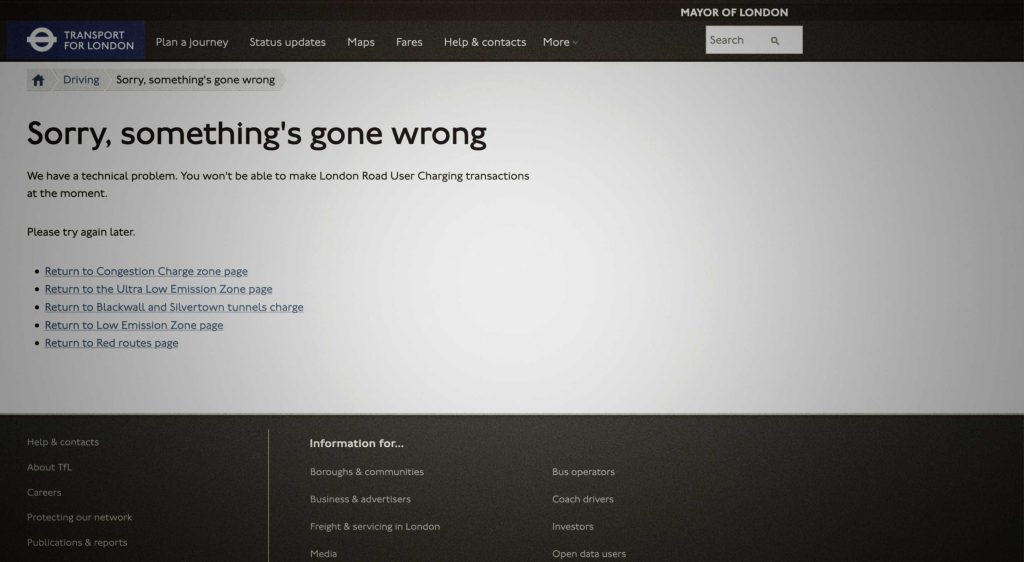
And the website responded:
Sorry, something’s gone wrong.
It continued:
Please try again later.
I didn’t know whether my payment had succeeded.
So I had to go back, enter all my details again and check whether the system was still asking me for money.
Eventually I discovered that it had, in fact, taken the payment.
There was something almost beautiful about it.
When I made a mistake:
£90 please.
When the system made a mistake:
Sorry, something’s gone wrong. Please try again later.
Apparently only one of us gets a second chance.
Intent and behaviour
This is what I keep coming back to when I think about Behaviour Engineering.
There is a lack of common sense in so many systems we build.
The intent doesn’t match the behaviour.
What is the intent of the Silvertown charging system?
Presumably:
People who use the tunnel should pay £4.
That’s reasonable enough.
I used it.
I was perfectly willing to pay £4.
They wanted £4.
I wanted to pay the £4 I owed.
Our intentions were completely aligned.
And yet somehow we’ve designed a system where I ended up paying £90.
That’s not an absence of technology.
It’s an abundance of technology wrapped around the wrong behaviour.
We do this constantly.
We take processes, digitise them, automate them, add websites, cameras, databases, payment systems and enforcement systems.
Then we expect humans to adapt themselves to whatever process we’ve created.
And when they don’t, we blame the human.
Of course drivers should read road signs.
Of course people should pay charges they owe.
Of course there eventually needs to be enforcement when people refuse to do that.
But humans also get distracted.
They misunderstand things.
They find themselves somewhere unfamiliar.
And sometimes they just forget.
Good systems should account for that.
Design for the behaviour you actually want.
If the behaviour you want is for me to pay £4, then help me pay £4.
If I make a small mistake, help me correct it.
And if I then refuse to correct it, punish me.
Because after the cameras, number plate recognition, databases, websites, payment systems, penalty calculations and four pages explaining exactly what will happen if I continue to get it wrong, I’m left with one remarkably simple question: