We Don’t Need an AI CRM. We Need to Stop Thinking in CRMs.
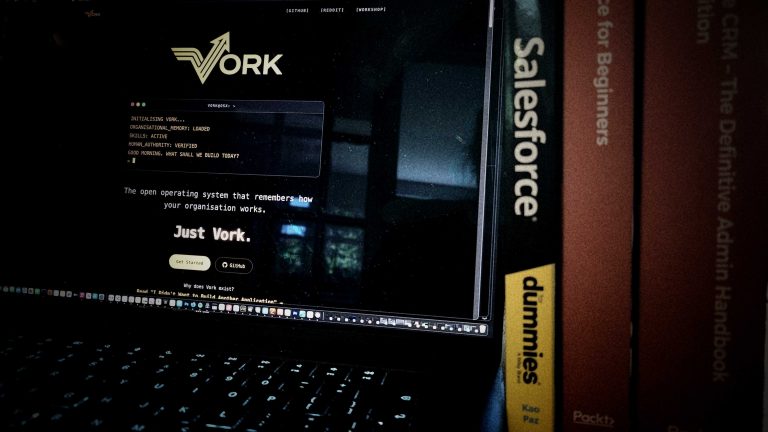
There’s a copy of Salesforce for Dummies sitting on my bookshelf. I noticed it while taking a photograph of Vork running on my laptop. The juxtaposition made me […]
Writing about software that should just work, open tools for work, songs with scars, and platforms that give people back their audience.
Security engineer. Bootstrapped founder. Songwriter. Builder of Jadaptive, Vork, Ludup and Fans.audio.
There’s a copy of Salesforce for Dummies sitting on my bookshelf. I noticed it while taking a photograph of Vork running on my laptop. The juxtaposition made me […]
When writing the code is no longer the hard part. I saw an interesting post on LinkedIn recently. An experienced software engineer had been experimenting with AI. He’d […]
For most of my career I thought software engineering was about writing software. I don’t think that anymore. Not because software is disappearing. Quite the opposite. We’re about […]
I am currently having an argument about a public footpath. This is already a sentence nobody wants to write. The argument concerns where a footpath actually runs across […]
A change log for the things I built, changed, removed, noticed or started questioning.
Sometimes the friction is the business model.
Software companies spend enormous amounts of time optimising onboarding.
Reduce the number of fields.
Improve conversion.
Make the trial easier.
Streamline checkout.
But sometimes the obvious question is:
Why is any of this here?
If the software costs nothing, why do I need an account?
If there’s no trial, why do you need to know who I am?
If there are no usage limits, why are you measuring my entitlement?
Sometimes we’re trying to optimise friction that only exists because the business model required us to create it.
Remove the business model and suddenly a surprising amount of the product can disappear with it.
The best onboarding flow might be no onboarding flow at all.
Your SaaS ARR might just be an implementation detail.
There’s a particular category of AI SaaS that increasingly makes me nervous.
It finds leads.
Processes receipts.
Handles email.
Researches companies.
Takes some AI behaviour, wraps it in an application, puts Stripe in front of it and charges $99 a month.
But what happens when the behaviour itself becomes portable?
Yesterday I realised I could build and test one of those behaviours myself in a couple of hours.
The SaaS company might have millions in ARR.
But the thing I’m actually paying for could increasingly be described as:
A behaviour I haven’t created yet.
That’s an uncomfortable place to build a moat.
Free means removing reasons not to try it.
I’ve been thinking about what “free software” actually means from the user’s perspective.
Free.
But register first.
Free.
But give us your email address.
Free.
But only for 30 days.
Free.
But only five users.
Free.
But you’ll need a credit card.
Every qualification creates another reason not to bother.
With one of our new products I’ve increasingly found myself wanting to remove all of them.
No registration.
No time limit.
No artificial limits.
Download it.
Use it.
Scale it.
If it’s useful, keep using it.
If you need our expertise, we’re here.
Maybe free isn’t a price point.
Maybe it’s the absence of friction.
Free Docker appliances for SSPR, JIT SSH certificates, WireGuard 2FA VPN and Java SSH APIs. Software is the gift; expertise is the paywall.
Visit →An open operating system for work. Build organisational behaviours. Software that remembers. Humans decide.
Visit →Songs, stories and reflections on love, life and the world around us.
Visit →Direct-to-fan infrastructure built around trust, ownership and lasting fan relationships.
Visit →