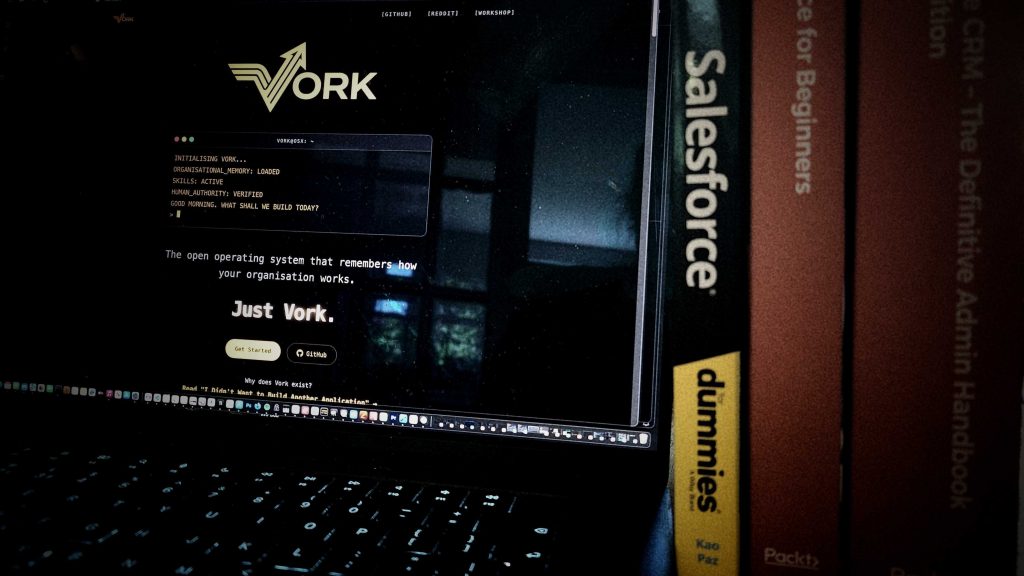
There’s a copy of Salesforce for Dummies sitting on my bookshelf.
I noticed it while taking a photograph of Vork running on my laptop.
The juxtaposition made me laugh.
On one side, Salesforce.
On the other, something I’ve spent the last few months building around an increasingly simple idea:
What if we stopped building applications for people to operate?
That sounds grander than I mean it to.
I’m not predicting the death of Salesforce.
I’m not even really writing about Salesforce.
I’m wondering whether we’ve reached the point where the abstraction we call a CRM is becoming less useful.
Because when I think about what I actually need from one, I don’t think I need a CRM at all.
I need to know what needs my attention
We have our own home-built CRM.
We’ve had it for years.
Interestingly, we call one of its central concepts Conversations.
A customer sends an email.
Our CRM already uses AI to work out whether it’s support, sales, accounts, a renewal, or something else.
It routes the conversation and even tries to suggest a response using the context we’ve given it.
That’s useful.
But somebody still has to operate the CRM.
They review what the AI decided.
They look at the history.
They decide whether the suggested response makes sense.
Maybe they need information from somebody else.
Maybe an engineer needs to investigate something.
Maybe I need to approve something.
Maybe nobody needs to do anything yet.
We’ve spent decades building software to organise all of this.
Inboxes.
Queues.
Tickets.
Statuses.
Dashboards.
Assignments.
Priorities.
Notifications.
Then we put humans in front of those systems and made operating them part of the job.
We’ve even added AI to ours.
And having done that, I’m starting to wonder if that’s backwards.
The AI CRM is still a CRM
There’s an obvious response to AI happening across the software industry.
Take the application we already have and add AI.
Put a chatbot in the corner.
Summarise the customer record.
Draft the response.
Suggest the next action.
Predict whether the opportunity will close.
All useful things.
But fundamentally the human is still operating the application.
You still have a CRM.
You’ve just given it an AI assistant.
I’m starting to think the more interesting question is:
Why is the human operating the CRM at all?
A conversation isn’t an email
This became much clearer while thinking about how I want Vork to handle our own customer communications.
A conversation might begin with an email.
But email is just how the conversation happened to arrive.
It could have arrived through a website.
Or Slack.
Or a chat interface.
Eventually it could be a telephone call.
Those are surfaces.
The thing underneath is still a conversation between somebody and the business.
And that conversation has a state.
What does this person want?
What has already happened?
What does the business know?
What needs to happen next?
Who needs to be involved?
Does anybody need to be involved?
That last question is becoming increasingly important.
Chris currently does this
We already have a version of this system.
His name is Chris.
When a support request comes in, Chris can understand it, respond to things he knows and find the right person for things he doesn’t.
If he needs engineering knowledge, he can ask an engineer.
The engineer doesn’t necessarily need to take ownership of the customer conversation.
They might simply say:
“That’s caused by the change we made in 1.7. You need to tell them to regenerate the configuration.”
Chris takes that information, understands it in the context of the conversation and communicates it back to the customer.
That is an incredibly important distinction.
The engineer provided knowledge.
They didn’t become the support agent.
Now imagine removing Chris from that particular loop.
Not removing the engineers.
Not removing me.
Not removing humans.
Removing the human whose job is primarily to move information between other humans and systems.
The AI receives the conversation.
It knows the customer.
It knows the product.
It knows previous conversations.
It knows what it is authorised to do.
If it has enough knowledge, it prepares the response.
If it doesn’t, it asks.
An engineer might get:
I need help answering this. Can you investigate why this configuration fails after upgrading to 1.7?
They investigate and reply.
The AI incorporates that knowledge and prepares the customer response.
A human reviews and authorises it.
The AI continues the customer conversation.
The engineer goes back to engineering.
That human oversight matters.
Behaviour Engineering isn’t about giving AI unlimited authority and hoping it behaves itself.
The objective is to remove unnecessary human involvement while preserving human control where it matters.
Automate the work. Keep the authority human.
That’s not an AI helpdesk.
That’s a different way of thinking about work.
So what does the interface look like?
This is where I caught myself making the same mistake.
I started thinking about screens.
What would the CRM replacement look like?
Would there be an inbox?
Would there be support queues?
Sales?
Projects?
Then I realised I was designing another application.
What I actually want when I open it in the morning is much simpler.
What needs my attention?
There might be a support conversation Vork can’t resolve.
A sales enquiry that needs my judgement.
A background job waiting for authorisation.
A project that’s blocked because somebody needs to make a decision.
An email Vork thinks I should personally see.
A question from an engineer.
Those things come from completely different parts of the business.
Why should I have to open five applications to discover them?
From my perspective they’re all the same thing:
Something needs me.
We’ve already invented this interface
Ironically, the interface might look less like Salesforce and more like Instagram.
A feed.
Not because I particularly want business software to become social media.
But because billions of people already understand the interaction model.
Scroll.
Read.
Swipe.
Respond.
Approve.
Ignore.
Drill into something when you need more context.
The feed isn’t the business record.
It isn’t even really an event stream.
It’s a view over work that currently requires human attention.
Underneath it might be a customer conversation, an approval, a background process, a sales opportunity or something we haven’t invented yet.
The user shouldn’t necessarily care.
They care about what needs doing.
Hide the machinery
There’s another implication.
Maybe we shouldn’t routinely show users everything the AI did.
If Vork receives a customer question, searches its knowledge, checks some records, asks another system for information and constructs a response, I’m not convinced I need a beautiful visualisation of its internal reasoning.
I need to know what happened.
I need the public conversation.
I need the current state.
I need the decisions that matter.
And when necessary, I need to be able to drill down into the events underneath it.
The machinery should be observable.
It doesn’t have to be the interface.
That’s another habit we’ve inherited from applications.
Because software traditionally required humans to perform the process, we designed interfaces exposing the process.
If the software performs the process itself, perhaps the interface should expose the outcome and the exceptions.
CRM might become a behaviour
This is the bit I find most interesting.
Perhaps Vork doesn’t need a CRM application.
It needs to know how our business behaves when somebody contacts us.
That’s different.
A sales enquiry arrives.
There are behaviours around that.
A support request arrives.
Different behaviours.
A renewal is approaching.
More behaviours.
A customer hasn’t renewed.
Another behaviour.
Someone asks a question we’ve never encountered before.
The system pauses and asks a human.
Once it knows the answer, perhaps the organisation knows it forever.
None of those things inherently require a CRM.
They require memory, state, instructions, authority and communication.
The CRM is just the application-shaped container we historically put around them.
Applications were an implementation detail
That may turn out to be one of the stranger things AI does to software.
For decades we’ve divided organisations into applications.
CRM.
Helpdesk.
ERP.
Project management.
HR.
Accounting.
Each has its database.
Its interface.
Its workflows.
Its notifications.
Its permissions.
Its own slightly different way of representing the same organisation.
Then we employ people to sit between them.
Copy this into that.
Read this email and create that ticket.
Update this status.
Tell that person.
Check this dashboard.
Move that card.
Maybe applications weren’t the destination.
Maybe they were simply the best abstraction we had when humans needed to tell computers exactly what to do.
AI changes that relationship.
The interface to logic increasingly becomes an instruction rather than code.
The interface to the organisation might increasingly become a conversation rather than an application.
And the interface to the human might eventually reduce to:
Here’s what needs your attention.
So what comes after CRM?
I don’t know yet.
I’m building towards an answer, which is much more interesting than pretending I already have one.
There will still be records.
There will still be data.
There will still be permissions, audit trails, integrations and all the boring but essential machinery underneath.
And there will absolutely still be humans.
But I’m increasingly convinced that putting AI inside the applications we’ve spent the last thirty years building is only the first step.
The bigger opportunity might be questioning why those applications exist in the first place.
I looked at that Salesforce for Dummies book beside Vork and initially thought I’d accidentally taken a funny photograph.
Now I think it might be a photograph of two different ideas about software.
One teaches the human how to operate the application.
The other is trying to learn how the organisation operates.
Maybe the future isn’t an AI CRM.
Maybe it’s not needing to think about the CRM at all.