I am currently having an argument about a public footpath.
This is already a sentence nobody wants to write.
The argument concerns where a footpath actually runs across our property in Cornwall. There are old maps. There are new maps. There are historical descriptions. There are photographs. There are stiles. There are people at the council.
You can probably imagine how much fucking fun we’re having.
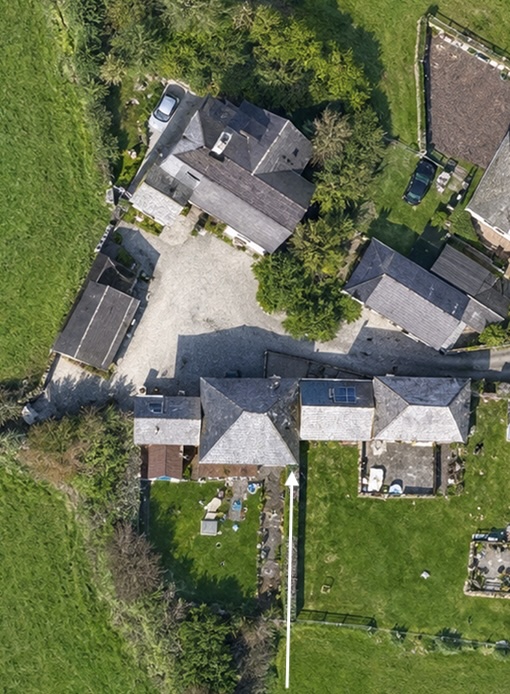
Recently, we were presented with another piece of evidence: an aerial image of our property.
And to be fair, it’s pretty compelling.
The line of the footpath approaches one of the buildings and appears to run straight into it.
There it is.
The building is quite clearly in the way.
Case closed.
There is only one small problem.
That isn’t how the fucking property looks.
Not how it looked fifty years ago.
Not how it looked before some building work.
Not a disagreement about whether a wall is six feet further to the left.
The physical configuration shown in the image simply does not exist.
I know this because I live there.
Then my porch moved
Once we’d spotted the first problem, we started looking at the image properly.
And things got weird.
My porch had moved.
We have a central porch on the front of the house. In the aerial image, it has apparently wandered substantially to the left.
Other buildings have changed shape.
Rooflines and structures don’t correspond properly with what’s actually on the ground.
Then we noticed the cars.
There are cars shown parked in locations which, according to the buildings and other features depicted in the very same image, they couldn’t actually get into or out of.
Apparently we don’t own a house in Cornwall.
We own a fucking escape room.
The reason appears to be that what we’re looking at isn’t simply an aerial photograph.
It has been digitally enhanced.
And increasingly, that means AI.
Enhanced doesn’t mean observed
There is nothing inherently wrong with enhancing aerial imagery.
Raw aerial and satellite imagery isn’t perfect. Resolution is limited. Images are captured at different angles and under different conditions. Mapping systems stitch imagery together, correct perspective, remove artefacts and increasingly use machine learning to create something cleaner and more useful.
Most of the time that’s brilliant.
The problem comes when we forget what has happened.
An algorithm looks at imperfect information and effectively says:
“Given what I can see, this is probably what is here.”
Usually, it’s probably right.
But “probably” is doing quite a lot of fucking work in that sentence.
Because once software starts reconstructing missing detail, some of the pixels you’re looking at no longer represent something a camera actually observed.
They represent an inference.
And an inference can be wrong.
We have become very familiar with this problem in text.
Ask an AI a question it doesn’t know the answer to and sometimes it will confidently invent one. We call it a hallucination.
We’re learning not to blindly copy AI-generated text into legal documents, academic papers or business reports without checking whether it’s true.
But an AI-enhanced aerial photograph has a rather more dangerous quality.
It still looks like a photograph.
The photograph shows…
That’s where this gets interesting.
Imagine someone looking at the image of our property without ever having visited it.
They see the footpath.
They see the building.
The conclusion is entirely reasonable:
“Look. The photograph clearly shows the path running into the building.”
Except it fucking doesn’t.
The photograph never saw that.
The processing system created an image in which that appears to be true.
That’s an important distinction when the image is being used as evidence.
In our case it’s almost funny.
AI appears to have moved my porch, remodelled parts of my property and trapped several cars.
And then the resulting image is capable of being used as evidence that a building obstructs a public footpath.
A building whose depicted geometry doesn’t fucking exist.
I don’t blame the person looking at the image.
I’d probably reach exactly the same conclusion if I’d never been to the property.
That’s precisely the problem.
Evidence needs provenance
I use AI every day.
I’ve written recently about how I use it in my own work. I’m not remotely interested in joining the queue of people shouting that AI is bad because sometimes it gets things wrong.
Humans get things wrong too.
Tools are tools.
But we need to understand what our tools are doing.
If AI improves an aerial image so I can see my roof more clearly on a mapping website, wonderful.
If AI removes a cloud from a satellite image, great.
If it reconstructs a blurry roofline so the map looks prettier, most people will neither know nor care.
But the moment that image is being used to establish what physically exists at a particular location, the rules have changed.
Where is a boundary?
Where does a public right of way run?
Was a structure there at a particular point in time?
Is something obstructed?
Has somebody carried out unauthorised development?
At that point I need to know something very important:
Which pixels were observed and which pixels were inferred?
Because an AI prediction doesn’t become a fucking fact simply because somebody rendered it at sufficiently high resolution.
Come and have a look
Fortunately, there’s a remarkably advanced technology available for resolving our particular disagreement.
It requires no GPU.
No large language model.
No image enhancement.
No subscription.
It’s called coming to the property and fucking looking at it.
So that’s what we’ve invited the council to do.
We have historical documentation describing the route. We have photographic evidence supporting it. We have physical features on the ground that can still be examined.
And we now have an aerial image being relied upon which demonstrably doesn’t accurately reproduce several physical features of the site.
At some point, reality gets a vote.
There is a wider lesson here, though.
As AI quietly becomes embedded inside the software we already use, we won’t always know we’re looking at AI output.
There won’t necessarily be a ChatGPT logo in the corner.
There won’t be a warning saying:
SOME OF THIS MAY HAVE BEEN MADE UP.
It’ll just be a better photograph.
A cleaner map.
A sharper satellite image.
A more complete dataset.
And because it looks authoritative, we’ll treat it as authoritative.
That’s fine right up until somebody asks it to settle an argument about reality.
AI can enhance evidence.
AI can help us understand evidence.
AI can even help us find evidence.
But when the distinction between what was observed and what was inferred disappears, we have a problem.
Because apparently my fucking porch has moved.
And I’d quite like it back.