How a failed UPS, a pointless train journey and an unexpected moment at the piano helped shape one of my songs.
There’s a moment in the creation of my song Rise that I sometimes wonder about.
Had a particular sequence of events not happened, would the song exist as it does today?
I suspect not.
And the rather ridiculous thing is that the sequence began with a failed UPS.
A journey to nowhere
I was supposed to be travelling from Grantham to Cornwall, where Kelly was waiting for me.
I’d arranged to go by train, so off I went.
By the time I reached Grantham, I’d become aware of some problems with our company network. It looked like a power cut at first. Our equipment was at my house, but I assumed it was something temporary.
So I got on the train.
By the time I reached King’s Cross, it had become obvious that something was seriously wrong.
I made the decision to abandon the journey and head home.
It turned out that the UPS had failed. Not merely failed to provide backup power, which would have been irritating enough. It had stopped delivering power altogether.
A device whose entire purpose was to provide uninterrupted power had managed to interrupt it rather comprehensively.
Wonderful.
Eventually, I got everything working again. But by then, there was no chance of continuing to Cornwall.
Hull Trains had been paid, I’d travelled halfway across the country and back, and I was exactly where I’d started.
Except I wasn’t quite.
The piano
I didn’t sit down to write a song.
I wasn’t planning a recording session or trying to solve a musical problem.
I was walking past the piano.
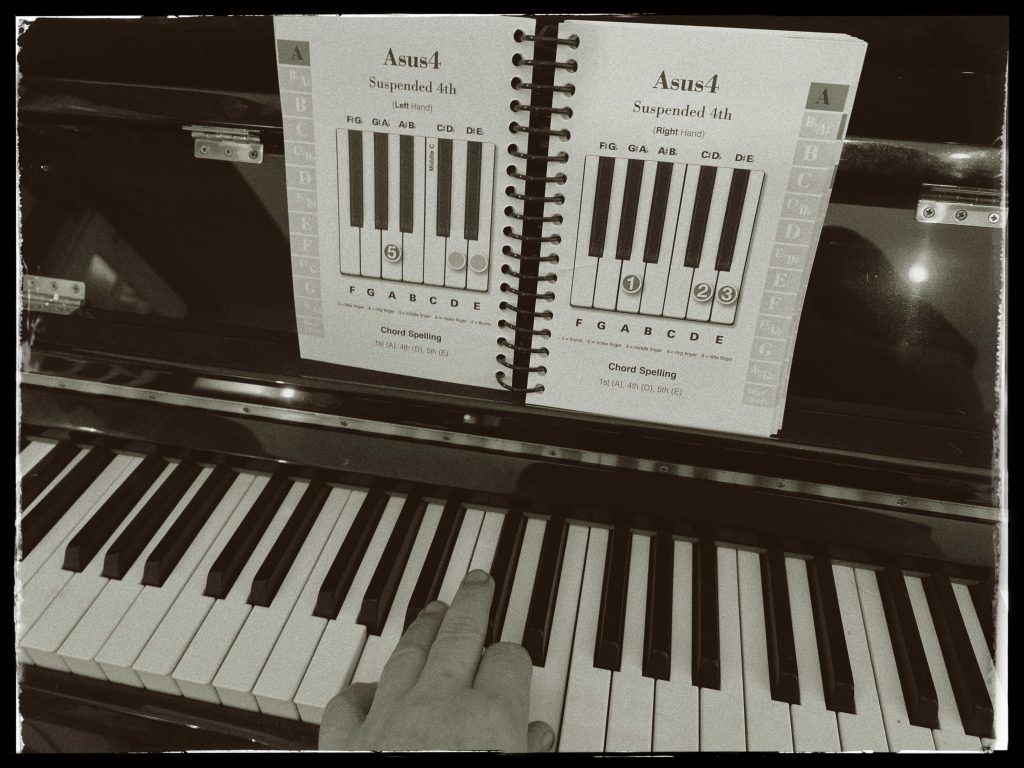
Rise was already something I’d been working on, and I happened to play the opening chords of the verse. A minor and G.
Two simple chords.
And then, for whatever reason, I played a suspended fourth.
Suddenly, I heard something.
A sus4 resolving to A minor. Then a suspended fourth resolving to G.
But it wasn’t simply the chords. It was the rhythm.
The figure had this particular movement, with the chord changes delayed by half a beat. The previous harmony carried just a little further into the next, creating a rhythmic tension that made the whole thing feel different.
And there it was.
The hook.
I recognised it immediately.
I can’t tell you why I played that suspension at that particular moment. I hadn’t been sitting there for hours searching for a hook. I wasn’t following some carefully constructed songwriting exercise.
I was walking past a piano after a thoroughly frustrating day.
And something arrived.
Sometimes it feels like a gift
I’ve spent countless hours making music.
Sometimes you can sit at an instrument for an entire afternoon, trying different chords, melodies, sounds and arrangements, and achieve precisely nothing.
You might have plenty of ideas. None of them quite works.
And then, occasionally, something happens.
You play a note you weren’t expecting to play. You change a chord. You move something rhythmically.
Suddenly, you hear where the music wants to go.
It’s difficult to describe that moment to someone who hasn’t experienced it.
I know perfectly well that songwriting involves skill, practice, experience and craft. I’ve spent years developing those things.
But sometimes inspiration doesn’t feel like the result of a deliberate process.
Sometimes it feels like a gift.
I’ve heard musicians describe songs as things they discover rather than things they invent, almost as though the music is already out there somewhere, waiting to be found.
I understand that feeling.
That afternoon, the hook for Rise felt like something I’d been given.
You can call it inspiration, creativity, coincidence or the product of years of musical experience.
I don’t particularly care what you call it.
I know how it felt.
And I know that if I’d successfully reached Cornwall that day, I wouldn’t have been walking past that piano at that moment.
One small idea changes everything
The hook is now fundamental to Rise.
In fact, it’s the first thing you hear.
The recording opens with that figure played on an electric piano. Then the bass comes in, moving around it, followed by the drums.
The arrangement grows from there.
It’s not a little embellishment buried somewhere in the song. It’s part of the song’s identity.
And all of that grew from a moment that lasted a few seconds.
That’s something I find endlessly fascinating about making music.
You can spend weeks developing a song, and then one tiny discovery changes your understanding of the entire piece.
Suddenly, you know what you’re doing.
You can hear the possibilities.
The music starts telling you where it wants to go.
Of course, there’s still work to do. Quite often an enormous amount of work.
But now you have something worth following.
And for me, that process is one of the great pleasures of recording music.
Not simply finishing a song.
Discovering what the song is going to become.
So where does AI fit into all this?
I’m a software engineer. I’ve spent much of my professional life building software, and I use AI extensively in that work.
I’ve seen firsthand how useful it can be.
I’m not frightened of the technology, and I’m certainly not going to pretend it isn’t capable of producing impressive results.
But when it comes to making my music, I have a rather different attitude.
I don’t want AI to write my songs for me.
Not because I believe a computer could never produce an interesting melody or a beautiful chord progression.
It probably could.
But that’s missing the point.
I don’t make music simply because I want more music to exist.
There’s already more music in the world than I could listen to in several lifetimes.
I make music because I love making music.
I love the hours spent experimenting with arrangements. I love discovering an unexpected sound on a synthesiser. I love working on a vocal passage that initially seems beyond me, then gradually finding that I can sing it.
And I love those extraordinary moments when something appears that I hadn’t consciously been looking for.
Why would I want to give that experience away?
If I could type a description into a computer and receive a finished version of Rise thirty seconds later, perhaps the result would sound wonderful.
But I wouldn’t have that story.
I wouldn’t have the memory of walking past the piano.
I wouldn’t remember the surprise of hearing that suspended chord.
I wouldn’t have experienced the excitement of realising that a small musical idea had fundamentally changed the song.
I’d have a recording.
But I’d have missed one of the things I love most about making one.
The other versions of Rise
There’s another thought I keep coming back to.
Every song we hear is just one version of what might have existed.
Change one decision, one circumstance, one moment of inspiration, and the result could be completely different.
What if the UPS hadn’t failed?
What if I’d stayed on the train?
What if I’d come home but never walked past the piano?
What if I’d played an ordinary A minor chord instead of that suspension?
Perhaps I’d have found another hook the following week.
Perhaps Rise would have become an entirely different song.
Perhaps it would have been better.
Perhaps it would have been worse.
We’ll never know.
I rather like imagining that somewhere in the multiverse, there are thousands of versions of Rise.
Some have different melodies. Some have different arrangements. Some probably never got finished.
And somewhere, there’s a version in which I made it all the way to Cornwall, the UPS carried on working, and none of this happened.
But this is the universe I live in.
And in this universe, an APC UPS died, Hull Trains got paid, and I found a hook that became fundamental to one of my songs.
That’s the version of Rise that exists.
It’s my version.
And I wouldn’t trade the experience of discovering it for a thousand instantly generated alternatives.
Copyright © 2024 Lee Painter and the APC UPS.
God rest its soul.