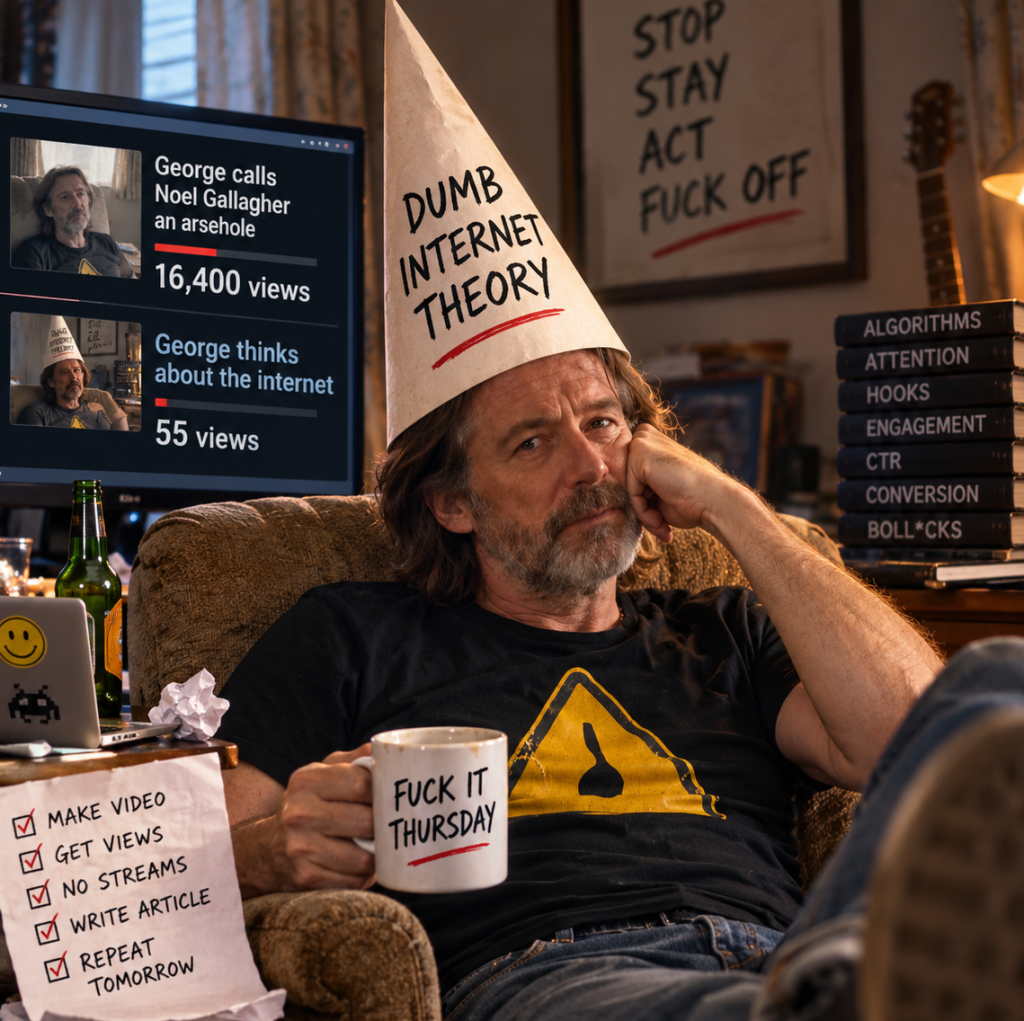
Fuck It Thursday. Or how I made a clever video about the stupidity of the internet, and the internet proved my point.
Yesterday, I declared Fuck It Wednesday.
For those who missed it, I’d discovered that 16,400 people had watched an AI-generated bloke called George describe Noel Gallagher as an arsehole.
Meanwhile, my Spotify account was reporting that minus one person was listening to my music.
Minus one.
I wrote an article about it. Had a laugh. Opened some wine. And reflected on the absurdity of spending more time marketing the things I create than actually creating them.
You’d think that would have been enough.
But no.
Today is Thursday.
And the internet has managed to get even fucking dumber.
An experiment in stupidity
Yesterday, I published another George video.
This one was different.
Instead of asking George what he thought of a celebrity, I decided to make something a little more interesting.
A clever little video about the internet itself.
The video was designed as a seamless loop. You weren’t supposed to realise it was looping until you’d already watched it go around.
That was the joke.
The format was part of the message. A piece of content that traps you in the very mechanism it was quietly making fun of.
I thought it was rather clever.
Apparently, I was alone.
55 views.
Nine engaged views.
YouTube helpfully informed me that the video was performing worse than usual and that more people were swiping away.
For comparison, the previous video in which George called Noel Gallagher an arsehole had attracted 16,400 views.
So there we have it.
George calls a celebrity an arsehole: 16,400 views.
George makes a clever joke about the internet: 55 views.
I appreciate this isn’t a scientifically rigorous experiment.
But it’s a pretty fucking entertaining result.
Stop. Stay. Act. Fuck Off.
Over the past few months, I’ve been experimenting with short-form video.
And like every other poor bastard trying to get noticed online, I’ve been learning about hooks, retention, engagement and calls to action.
There’s a simple framework that sums it up.
Stop. Stay. Act.
First, make somebody stop scrolling.
Then give them a reason to stay.
Finally, persuade them to do something.
Simple enough.
And, to be fair, it works.
I’ve used it. I’ve seen the results. I understand the mechanics.
But here’s the problem.
My clever little looping video didn’t have a conventional hook.
It couldn’t.
The whole fucking point was that you weren’t supposed to know what was happening until you realised you were watching the same thing again.
If I’d started with a big caption saying, “WATCH THIS CLEVER LOOP ABOUT THE INTERNET!”, I’d have destroyed the joke before it began.
If I’d explained the premise, there would have been no surprise.
If I’d inserted some attention-grabbing nonsense into the first second, I’d have compromised the timing.
The creative idea depended on withholding information.
The algorithm wanted me to reveal it.
And apparently, in 2026, the algorithm gets the final say.
When the hook becomes more important than the idea
Think about that for a moment.
We’re increasingly designing creative work around the first second of consumption.
Not the quality of the idea.
Not the emotional impact.
Not the craftsmanship.
The first fucking second.
Does it stop somebody scrolling?
If not, it might as well not exist.
Imagine applying that logic to everything.
A novel must reveal its twist in the first paragraph.
A film must deliver its climax before the opening credits.
A comedian must explain the punchline before telling the joke.
A song must reach its chorus before the first verse.
And if the audience doesn’t immediately understand what they’re getting, the work is considered a failure.
That’s not creativity.
That’s packaging.
And I’m beginning to wonder whether we’ve become so good at packaging things that we’ve forgotten why we were creating them in the first place.
The difference between attention and interest
But there’s another problem, and it’s arguably worse.
Let’s go back to George calling Noel Gallagher an arsehole.
16,400 views.
A success, by the standards of social media.
Except what did it actually achieve?
My music was playing in the background.
I wrote it. I recorded it. I produced it.
Did those 16,400 views result in thousands of people discovering my music?
Not according to Spotify.
I had 18 streams in the previous seven days.
Eighteen.
So I managed to create something that attracted thousands of people’s attention without generating any meaningful evidence that they were interested in the thing I actually wanted to share.
And this is where Stop / Stay / Act starts to fall apart.
You can make somebody stop.
You can make them stay.
You can even make them act.
But if the action doesn’t benefit what you’re actually trying to achieve, what have you accomplished?
You’ve entertained somebody for six seconds.
Congratulations.
So has a cat falling off a sofa.
The wrong audience is still an audience
Here’s the uncomfortable part.
Those 16,400 people weren’t necessarily potential fans of my music.
They were people who wanted to hear somebody call Noel Gallagher an arsehole.
And I gave them exactly what they wanted.
The video worked.
The audience behaved exactly as expected.
The platform did its job.
The problem was that the audience’s reason for watching had almost nothing to do with my reason for creating it.
And that distinction is enormous.
It’s not enough to attract attention.
You have to attract attention from people who might actually care about what you’re offering.
Otherwise, you’re just accumulating numbers on a dashboard.
Which brings me neatly back to software.
I’ve spent decades developing software products.
Real products. Solving real problems.
And now I find myself spending ridiculous amounts of time trying to persuade people to notice them.
Some people click the advertisements.
Some visit the websites.
Some even download the software.
And then they don’t install it.
Brilliant.
I’ve successfully persuaded somebody to take an action that goes absolutely nowhere.
Stop.
Stay.
Act.
Download.
Fuck off.
It’s like running a restaurant where everybody comes in, reads the menu, orders dinner, and then leaves before the food arrives.
And naturally, the marketing industry’s answer is to optimise the menu.
The internet isn’t broken
Yesterday, I called this Broken Internet Theory.
But I’ve changed my mind.
The internet isn’t broken.
It’s doing precisely what we’ve trained it to do.
Platforms optimise for attention.
Creators optimise for distribution.
Advertisers optimise for clicks.
And audiences learn to expect immediate gratification.
Everybody is optimising something.
But somewhere along the way, we’ve lost sight of what any of it is supposed to achieve.
A video with 16,400 views can be commercially worthless.
A video with 55 views can contain a genuinely good idea.
A thousand software downloads can produce no users.
And a musician can spend more time creating promotional content than creating music.
None of these outcomes necessarily indicates that the technology has failed.
In fact, the technology may be working extraordinarily well.
It’s the incentives that are fucking stupid.
And when you build an entire ecosystem around rewarding particular behaviours, you shouldn’t be surprised when everybody starts behaving that way.
Dumb Internet Theory
So here’s my theory.
The internet has become extraordinarily efficient at rewarding content that’s easy to consume, rather than content that’s worth consuming.
Not exclusively, of course.
There are wonderful things online. Extraordinary musicians, writers, filmmakers, educators and engineers producing remarkable work.
But they’re competing for attention in an environment where a six-second insult can outperform months of creative effort.
And the rational response is to make more six-second insults.
Which means the system encourages more of the very content that makes the system increasingly dumb.
A self-reinforcing loop.
Rather like my video.
Except nobody watched that.
Fuck It Thursday
So here we are.
Thursday, 15 October 2026.
Yesterday was Fuck It Wednesday.
Today is officially Fuck It Thursday.
And I’ve learned something important.
I can make a video that gets 16,400 views.
I can make a video that’s clever.
But making a video that’s clever, gets 16,400 views, reaches people who might actually care about my music, and persuades them to listen?
That’s a completely different fucking ball game.
And I’m not convinced anybody has a reliable formula for that.
There are frameworks, tactics, strategies, courses, consultants and endless advice about how to succeed online.
But none of them can guarantee that the people who stop scrolling are the people who might care about what you’ve made.
And even when they are, attention doesn’t automatically become interest.
Interest doesn’t automatically become action.
And action doesn’t automatically become anything useful.
Meanwhile, the hours disappear.
Hours I could have spent writing music.
Hours I could have spent developing software.
Hours I could have spent doing literally anything other than trying to persuade an algorithm that my existence is worth acknowledging.
Instead, I’ve spent another morning analysing the performance of a fictional man talking bollocks.
And now I’ve written another fucking article about it.
Which I’ll have to promote.
Probably with a video.
Which will need a hook.
And a reason to stay.
And a call to action.
Oh, for fuck’s sake.
Welcome to Dumb Internet Theory.
The internet isn’t broken.
It’s just fucking dumb.
And apparently, so am I, because I’ll probably do it all again tomorrow.
Lee Painter is a musician, songwriter and software engineer. He creates music, software and an AI character called George, who is currently considerably better at attracting attention than either of the other two.
You can find his music on Spotify. Assuming Spotify has finished subtracting listeners.