Six months ago I’d have told you bootstrapping was dead.
Not struggling.
Not harder.
Dead.
Modern software is expensive to build.
Not because of the code.
The code is often the easy part.
It’s everything that comes afterwards.
Compliance.
Auditing.
Security reviews.
Penetration testing.
Specifications.
Procurement.
Risk assessments.
The endless parade of checkboxes that appear long before anyone has actually agreed to buy the thing.
If you’re trying to sell enterprise software, it can feel impossible.
How do you bootstrap something when the customer expects the paperwork before you’ve made your first sale?
How do you fund the process when the process itself costs money?
For a long time I didn’t have a good answer.
Then I realised I was measuring the wrong thing.
The assumption hiding underneath most software companies is that the goal is revenue.
Get leads.
Convert prospects.
Close deals.
Grow revenue.
Sounds reasonable.
It’s also where many bootstrappers get stuck.
Because revenue comes at the end of a chain of events.
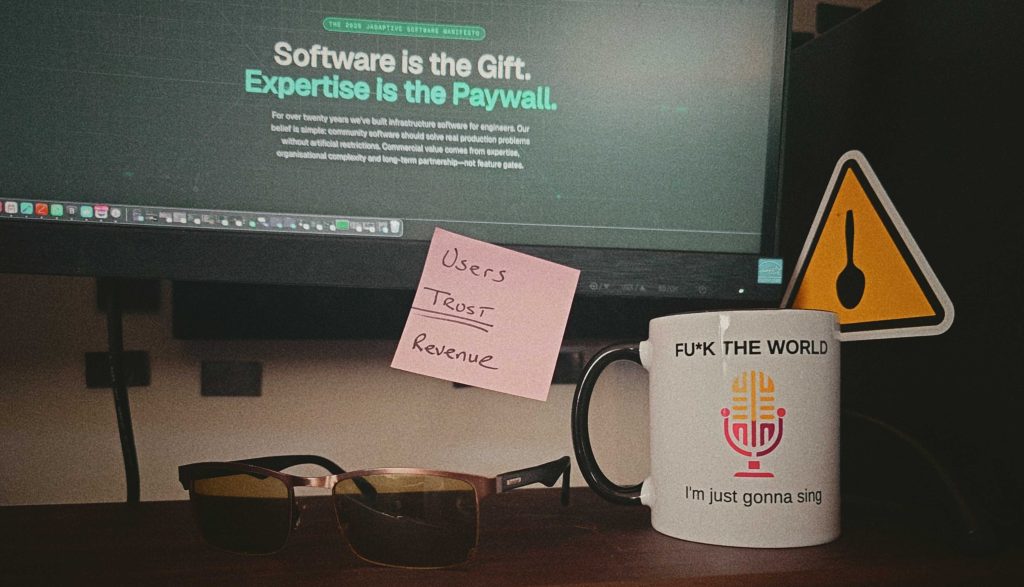
Users come first.
Trust comes first.
Value comes first.
Somewhere along the way we’ve started trying to skip those steps.
We’ve become obsessed with selling software before anyone is actually using it.
I know because I fell into exactly the same trap.
For years we added more forms.
More gates.
More nurturing campaigns.
More marketing automation.
More funnel.
The result?
People downloaded software.
Then never installed it.
We collected email addresses.
Then emailed people who ignored us.
We spent more money trying to optimise a process that fundamentally wasn’t working.
At some point you realise the modern funnel is just spam with better branding.
The whole system is backwards.
I’m an engineer.
I don’t want leads.
I want users.
I want people solving problems.
I want software providing value.
Everything else should follow from that.
For years I kept asking the wrong question.
How do we build a better funnel?
How do we convert more leads?
How do we nurture prospects?
Then one day it occurred to me that I was playing someone else’s game.
It reminded me of WarGames.
“A strange game. The only winning move is not to play.”
You can’t out-market companies with venture capital.
You can’t outbid them on Google.
You can’t build a bigger SDR team.
So stop trying.
Play a different game.
Build software people can actually use.
Help them solve real problems.
Earn trust.
Then sell the expertise.
That’s a game a bootstrapper can actually win.
That realisation eventually led us to a new philosophy:
Software is the gift. Expertise is the paywall.
The software should earn trust.
The expertise should earn revenue.
Not the other way around.
Twenty years ago this approach happened almost by accident.
We uploaded releases to SourceForge.
Submitted news updates.
Got featured.
People downloaded the software.
Used it.
Loved it.
Hated it.
Reported bugs.
Requested features.
Told their friends.
You didn’t spend all day thinking about marketing.
The software did the marketing.
That world is gone.
The field of dreams era ended years ago.
Today there is more noise.
More competition.
More choice.
More software than anyone could possibly evaluate.
Building something and hoping people discover it is no longer a strategy.
But neither is building an elaborate sales funnel and hoping somebody eventually clicks enough buttons to become a customer.
The challenge hasn’t changed.
The path has.
What changed my mind was AI.
Not because AI writes code.
Everyone is talking about that.
The more important shift is speed.
A while ago I spent several weeks prototyping a new SSH product inside our framework.
Then one weekend I rebuilt it from scratch using GitHub Copilot.
Standards-based.
DPoP support.
Test frameworks.
The lot.
Without writing a single line myself.
That was the moment I realised something.
The cost of experimentation has collapsed.
The cost of building a useful product has collapsed.
The cost of proving an idea has collapsed.
What hasn’t collapsed is trust.
Trust remains stubbornly expensive.
And trust is now the real bottleneck.
Nobody trusts software vendors.
Nobody trusts marketing.
Nobody trusts “commercial open source”.
Nobody trusts the endless parade of growth hacks and lead magnets and gated content.
Everyone has been burned too many times.
Which means the winning strategy isn’t bigger funnels.
It’s credibility.
Usefulness.
Visibility.
Community.
You have to engage directly with users.
You have to help.
You have to prove you’re solving a real problem.
Only then do you earn the right to sell something.
That’s the part most startup advice misses.
The conversation is always about scale.
Rarely about trust.
Investors understand scale extremely well.
They can throw money at the problem.
Marketing teams.
Sales teams.
Customer success teams.
More people.
More campaigns.
More outreach.
Eventually enough things stick to enough walls.
That’s a perfectly valid strategy.
It’s just not a bootstrap strategy.
A bootstrapper has to play a different game.
The game isn’t:
How do I sell more software?
The game is:
How do I create enough value that people want me around?
That’s a much harder question.
It’s also a more sustainable one.
People often ask me what I’d do if I had to start again from scratch.
No audience.
No customers.
No reputation.
No products.
Just experience.
The answer is surprisingly simple.
I’d build products.
I’d build users.
I’d build trust.
And I’d ignore revenue for the first six months.
Most founders do that in reverse.
That’s why so many never get anywhere.
The funny thing is I still think bootstrapping is harder than it was twenty years ago.
Much harder.
Back then one person could build something meaningful.
Today you need developers, testers, DevOps engineers, marketers, sales engineers, compliance processes and security reviews.
Everything got more complicated.
Everything got more expensive.
Everything got slower.
Yet somehow I find myself more optimistic than I was six months ago.
Because the barriers moved.
They didn’t disappear.
They moved.
The old barrier was building software.
The new barrier is earning trust.
And trust doesn’t care how much funding you raised.
Trust doesn’t care how many SDRs you hired.
Trust doesn’t care how sophisticated your funnel is.
Trust is earned one user at a time.
So is it still possible to bootstrap a software company in 2026?
Yes.
The straps just got shorter.